

Every second, more than 99,000 searches are performed on Google around the world. Behind each of these searches is a person with a question, a need, or an immediate purchase intent.
The crucial question for any business is therefore not whether potential customers are searching online, but rather: who do they find first when they do? You or your direct competitors?
Being on the second page of Google is practically the same as not being there. Several studies on user behavior show that more than 75% of clicks are concentrated on the first three organic results on the first page.
SEO positioning (Search Engine Optimization) is neither a temporary technical trick nor an unnecessary expense: it is a highly profitable digital asset for any business in the medium and long term. In this comprehensive guide, we explain how modern SEO works, what its main pillars are, and what steps you should follow to make search engines your main source of customers.
1. Why Is SEO the Most Profitable Asset for Your Business?
Businesses often hesitate between investing in paid digital advertising (Google Ads, Meta Ads) or organic optimization (SEO). In reality, both strategies can complement each other, but SEO has a structural advantage that paid advertising cannot match: its cumulative effect and long-term sustainability.
Paid Advertising (PPC): You stop paying → The traffic disappears immediately.
SEO Positioning: You build your authority → Traffic continues to arrive consistently without paying for every click.
Strategic Benefits of Organic Traffic
- Trust and credibility: Users naturally tend to trust organic results more than sponsored ads. Appearing among the top results gives your brand an implicit image of authority within its industry.
- High purchase-intent traffic: Unlike social media, where you interrupt users while they are browsing for entertainment, on Google users are actively searching for a solution to their problem at that specific moment.
- Long-term return on investment (ROI): A well-positioned article or optimized service page can continue attracting qualified customers for months or even years without requiring payment for every click received.
2. The 3 Pillars of Modern SEO: The Triangle of Digital Success
For Google to reward your website with higher rankings, your strategy must balance three fundamental areas: Technical SEO, On-Page SEO (content), and Off-Page SEO (authority). If one of these pillars is missing, the effectiveness of the entire structure is reduced.
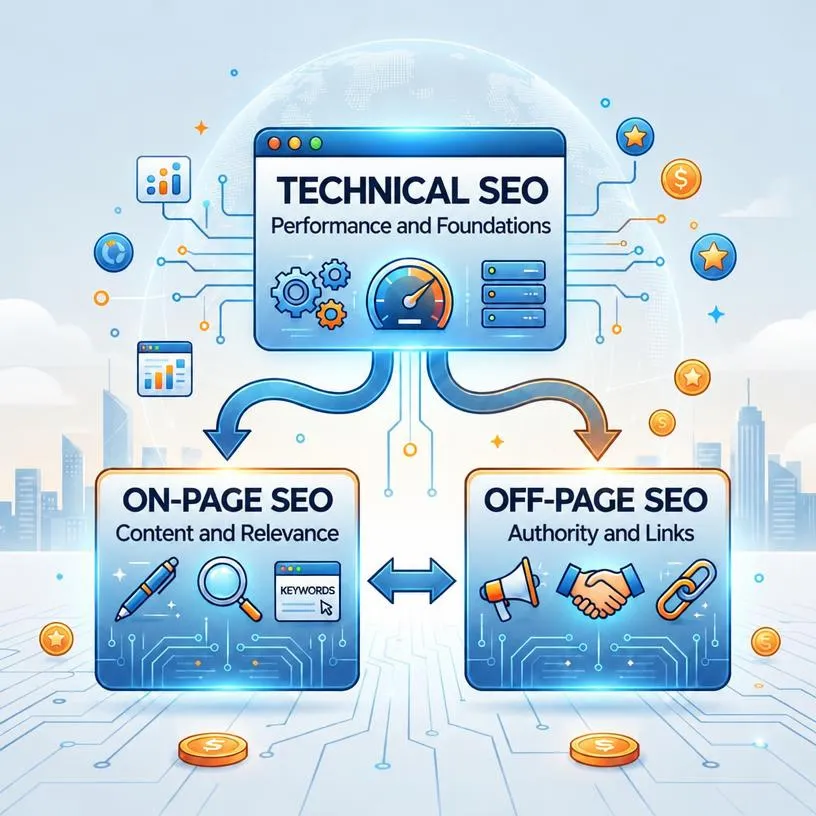
TECHNICAL SEO → ON-PAGE SEO ↔ OFF-PAGE SEO
Pillar 1: Technical SEO (The Foundation Everything Depends On)
Technical SEO ensures that Google’s crawlers can access, interpret, and index your website without obstacles or errors.
- Speed and Core Web Vitals: Google places significant importance on the browsing experience. Metrics such as LCP (Largest Contentful Paint), FID/INP (interaction responsiveness), and CLS (visual stability during loading) are important ranking factors.
- Security (HTTPS protocol): An active SSL certificate is essential. Google may flag unencrypted websites as “not secure,” which can discourage users and negatively affect trust.
- Indexing and crawling: It is essential to have an up-to-date
sitemap.xmlfile submitted to Google Search Console, as well as a properly configuredrobots.txtfile to avoid blocking important pages. - Mobile-Friendliness (Mobile-First): Google uses the mobile version of your website to determine rankings across devices. A website that is not smooth and intuitive on smartphones may struggle to compete for top positions.
Pillar 2: On-Page SEO and Search Intent (Content That Meets User Needs)
On-Page SEO involves optimizing each page individually so that it is highly relevant to a specific search query.
Google’s algorithm no longer simply counts how many times a keyword is repeated. Today, it uses natural language processing to understand search intent.
There are four main types of search intent:
- Informational: “How can I improve my website speed?”
- Navigational: “Uniksit login.”
- Commercial: “Best SEO agencies comparison.”
- Transactional: “Hire an SEO audit for an online store.”
Key On-Page Optimization Factors
- Unique H1 tag and logical heading hierarchy (H2, H3): Organize information to make it easy to scan and understand.
- SEO title tags and meta descriptions: They should contain the primary keyword and be compelling enough to maximize CTR (click-through rate).
- In-depth semantic content: Fully answer users’ questions by incorporating related terms, synonyms, and answers to frequently asked questions.
- Internal Linking Architecture: Strategically connect informative blog articles to sales and service pages to guide users toward conversion.
Pillar 3: Off-Page SEO and Authority (Your Domain’s Reputation)
Off-Page SEO includes all external signals indicating to Google that your website is a trustworthy and authoritative source within your industry.
- Quality backlinks (Link Building): When relevant and established websites link to your content, they act as “votes of confidence” in Google’s eyes. In modern link building, the quality and topical relevance of a link are much more important than quantity.
- Unlinked brand mentions: Regular mentions of your brand in media outlets, specialized forums, and industry publications strengthen your digital presence.
- Social media presence and referral traffic: Although social media does not directly transfer SEO authority from an algorithmic perspective, social amplification attracts visitors, generates natural mentions, and increases the reach of your content.
3. Local SEO: The Key to Dominating Your City or Region
If your business provides in-person services, has a physical office, or targets a specific local market, local SEO can be an effective way to attract customers who are ready to take action.
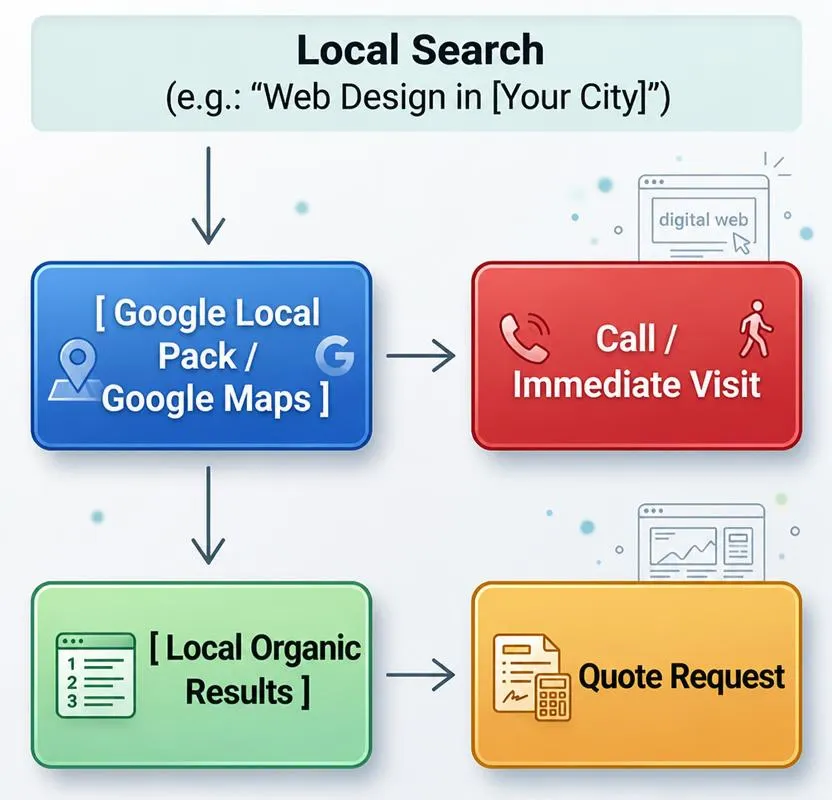
Local Search (“Web Design in [Your City]”)
↓
Google Local Pack / Google Maps → Immediate Call / Visit
↓
Local Organic Results → Quote Request
Key Factors for Successful Local SEO
- Optimized Google Business Profile: Complete 100% of your profile information, including accurate categories, business hours, professional photos of your projects, and an up-to-date service catalog.
- Active Review and Rating Strategy: Positive and detailed reviews from real customers are an important factor for appearing in the Local Pack (the map section highlighted by Google).
- NAP Consistency (Name, Address, Phone): Make sure your business name, physical address, and phone number appear exactly the same way on your website, business directories, and social media profiles.
- Geolocated Landing Pages: If you offer your services in several cities or geographic areas, create specific pages optimized for each location without relying on duplicate content.
4. The 5 Most Common SEO Mistakes That Hold Your Website Back
Many businesses invest time and resources into their websites without getting the expected results because of technical or strategic mistakes that can easily be avoided:
- Ignoring Long-Tail Keywords: Ranking for generic and extremely competitive terms such as “shoes” or “marketing” can be expensive and difficult. Focusing on specific terms such as “web design for dental practices” can attract traffic that is more likely to become a customer.
- Duplicate or Low-Quality Content: Copying text from suppliers or competitors, or producing superficial content without added value, can cause Google to ignore or deindex your pages.
- Failing to Optimize Images: Uploading high-resolution photographs without compressing them or using descriptive
alttags can slow down your website and cause you to miss opportunities to receive traffic from Google Images. - Not Updating Older Content: Search rankings are not static. Articles that are not updated with recent information can lose relevance compared with competitors offering fresher content.
- Failing to Measure and Analyze Data: Doing SEO without regularly checking Google Search Console and Google Analytics 4 is like navigating blindly. You need to know which search queries generate traffic, which pages have the highest bounce rates, and where conversions are being lost.
5. Roadmap: Action Plan to Start Your SEO Strategy
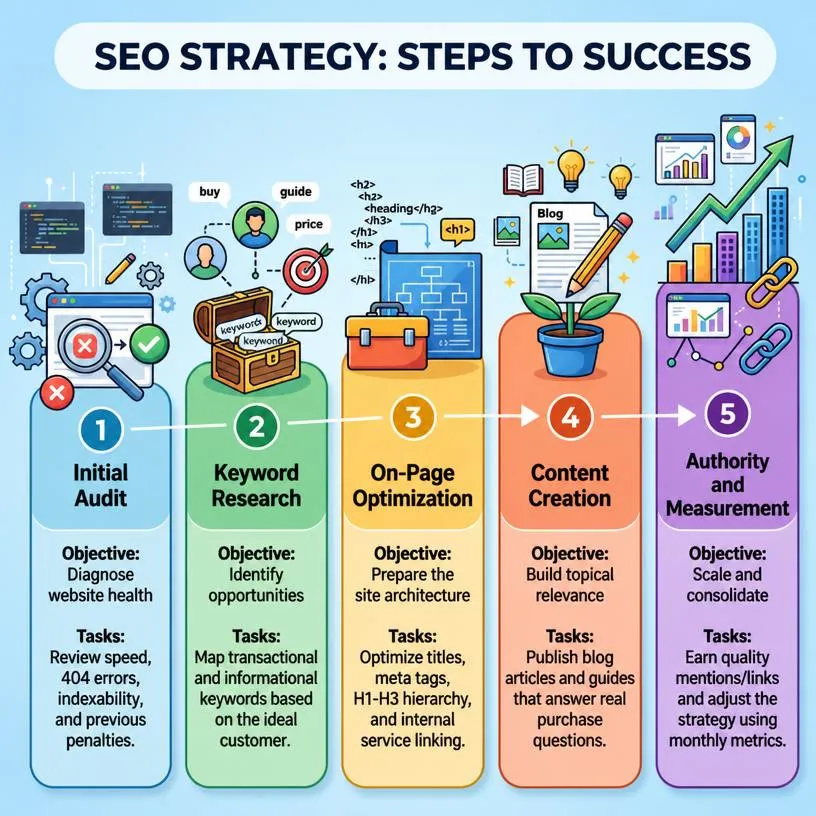
To implement an effective and structured SEO strategy, we recommend following this five-step process:
Image type: Infographic showing the 5 steps of an SEO strategy:
1. Initial Audit → 2. Keyword Research → 3. On-Page Optimization → 4. Content Creation → 5. Authority and Measurement
| Phase | Main Objective | Key Tasks |
|---|---|---|
| 1. Initial Audit | Diagnose website health | Check speed, 404 errors, indexing, and any previous penalties. |
| 2. Keyword Research | Identify opportunities | Identify transactional and informational keywords that match your ideal customer. |
| 3. On-Page Optimization | Prepare the website architecture | Optimize titles, meta descriptions, H1-H3 hierarchy, and internal links to service pages. |
| 4. Content Creation | Build topical relevance | Publish blog articles and guides that answer customers’ real questions before they make a purchase. |
| 5. Authority and Measurement | Develop and strengthen authority | Earn quality mentions and backlinks, then adjust the strategy based on monthly data. |
Conclusion: The Best Time to Position Your Website Was a Year Ago; the Second-Best Time Is Today
Search engine positioning is not a magic formula that produces results overnight: it is a long-term race where consistency, technical precision, and content quality make all the difference.
Every day your website remains unoptimized for search engines represents potential customers who may end up choosing your competitors simply because they appeared first on their screen.
At Uniksit.com, we specialize in transforming websites into highly profitable business assets. We develop technical SEO, content optimization, and conversion-focused web design strategies so your business can reach higher positions on Google and attract a consistent flow of qualified prospects.
Would you like to know why your website isn’t appearing on the first page of Google?
Request an SEO Audit from Uniksit and discover the exact plan to multiply your organic visibility.